
Author Note: Written by the Health for Life editorial team. I lost 22 pounds over eight months after my last physical, and the question “where does it actually go” bugged me the entire time. This piece pulls from that experience and from peer reviewed research, including the original BMJ fat metabolism study.
The Question That Started It All
When you lose weight where does it go is a question that sounds simple until you actually try to answer it. I remember standing on my bathroom scale about three years ago, ten pounds lighter than the month before, and just staring at the number like it owed me an explanation.
My gut reaction was that the fat had turned into energy and disappeared. That is what I always assumed. Turns out almost everyone assumes that, including a lot of doctors and personal trainers who deal with weight loss every single day.
So I went looking for a real answer instead of a guess, and what I found changed how I think about diet and exercise completely.
What Body Fat Really Is
Before you can understand where fat goes, you need to know what it actually is while it is sitting on your body.
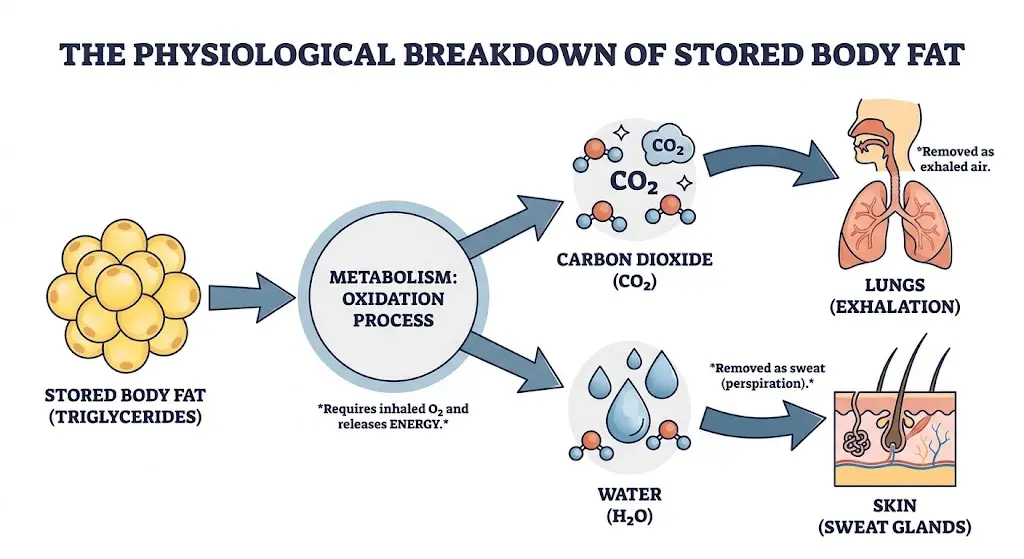
Fat is stored in your body as triglycerides, which are molecules made of carbon, hydrogen, and oxygen. Your body builds these triglycerides out of extra calories you eat and don’t burn off, whether those calories came from pasta, olive oil, or a candy bar. It does not matter much where the calories came from originally. Once stored, fat is just fat.
Those triglycerides sit inside fat cells, called adipocytes, waiting to be used for energy. Think of them as your body’s emergency fuel tank, one that never runs empty on its own because your body is very good at holding onto reserves.
Key takeaway: Fat is not waste sitting in your body. It is stored energy, and your body only releases it when you truly need more fuel than your food is providing.
Where Does the Fat Actually Go
When you lose weight, your body breaks down triglycerides into carbon dioxide and water through a process called oxidation. Most of that mass, about 84 percent, leaves your body as carbon dioxide when you exhale. The remaining 16 percent leaves as water through urine, sweat, and breath.
That answer surprises almost everyone, including health professionals. A well known 2014 study published in the British Medical Journal tested 150 doctors, dietitians, and personal trainers and found that <cite index=”8-1″>only three of them gave the right answer, meaning 98 percent of health professionals in the survey could not correctly explain how weight loss works</cite>.
The Numbers Behind Fat Loss
The exact math is what makes this topic so interesting, and it is backed by hard chemistry, not guesswork.
Researchers from the University of New South Wales calculated that <cite index=”22-1″>to burn 10 kilograms of fat, a person needs to inhale 29 kilograms of oxygen, and that process produces 28 kilograms of carbon dioxide and 11 kilograms of water</cite>. In pounds, that works out to roughly 8.4 pounds exhaled as carbon dioxide and 1.6 pounds turned into water for every 10 pounds of fat lost.
Here is the breakdown in simple terms:
- Lose 10 pounds of fat: 8.4 pounds leave through your lungs, 1.6 pounds become water
- Lose 20 pounds of fat: roughly 16.8 pounds are exhaled, about 3.2 pounds leave as water
- Lose 50 pounds of fat: around 42 pounds go out through your breath, the rest through fluids
Your lungs, not your muscles or your bathroom habits, do most of the heavy lifting.
Sweat, Pee, and the Myths People Still Believe
There are three fat loss myths I hear constantly, and all three are wrong.
Myth 1: Fat turns into muscle. Fat and muscle are two completely different types of tissue. One cannot physically convert into the other, no matter how many crunches you do.
Myth 2: You sweat fat out. Sweating cools your body down. It sheds water weight, which comes right back once you rehydrate. It is not a fat loss mechanism on its own.
Myth 3: Fat leaves through your digestive system. Fiber is really the only thing that passes through your gut mostly undigested. Fat and carbs get absorbed into your bloodstream long before they reach your colon.
If you are curious how these myths connect to broader metabolism questions, our [internal link: guide on how metabolism actually works] breaks it down further.
Why the Scale Lies to You Sometimes
This part frustrated me the most during my own weight loss, so let me save you some confusion.
The scale measures total body weight, not fat specifically. That number includes water, muscle, food still in your system, and yes, fat. This is why you can eat clean for a week and see almost no movement, then suddenly drop two pounds overnight after a normal weekend. Water retention shifts constantly based on sodium intake, hormones, and even how much you slept.
Muscle also throws people off. If you start strength training while cutting calories, you might build a little muscle while losing fat at the same time. Your pants get looser, but the scale barely budges. That is not a plateau. That is your body composition actually improving.
My Own Weight Loss and What I Learned
I want to get specific here because the theory only means so much until you have lived it.
When I started paying closer attention to my habits, I was eating out almost every day and barely moving outside of work. I dropped fast food to twice a week, started walking after dinner, and tracked my food loosely instead of obsessively. Over eight months I lost 22 pounds, and the biggest surprise was how much easier breathing and stairs felt long before my weight looked dramatically different in the mirror.
I built out my whole tracking system and food swaps on www.Healthforlifee.com, mostly because I could not find one site that explained both the science and the day to day habits without either oversimplifying it or drowning me in jargon. If you want the exact meal structure I used, it is all documented there.
The lesson that stuck with me is that fat loss is slow, boring, and mostly invisible while it is happening. You do not feel your lungs working overtime to exhale carbon dioxide. You just notice, one day, that your jeans fit differently.
Beginner Mistakes That Slow Fat Loss
A few habits I see constantly, and made myself early on:
- Cutting calories too aggressively. Your body holds onto fat harder when it thinks it is starving, and you lose muscle along with fat.
- Ignoring protein. Low protein diets make it more likely you lose muscle mass instead of fat mass.
- Judging progress by the scale alone. Weight fluctuates daily for reasons that have nothing to do with fat.
- Skipping sleep. Poor sleep messes with hunger hormones like ghrelin and leptin, making cravings worse.
- Doing endless ab workouts to spot reduce belly fat. Your body decides where fat comes off first, and it is usually not the area you are training hardest.
What Actually Helps Your Body Release Fat
None of this requires anything extreme. The basics work because they are basics.
- Eat in a moderate calorie deficit, not a drastic one
- Prioritize protein at each meal to protect muscle
- Move daily, even if it is just walking
- Sleep seven to nine hours most nights
- Stay consistent for months, not days
Bold claim, but true: consistency beats intensity almost every time when it comes to fat loss that actually sticks.
FAQs
Does fat turn into muscle when you lose weight? No. Fat and muscle are different tissues that cannot convert into one another. You can lose fat and build muscle at the same time, which changes your shape, but one does not become the other.
How much fat do you exhale when you lose weight? About 84 percent of lost fat leaves your body as carbon dioxide through your lungs. The remaining 16 percent leaves as water through urine, sweat, and breath.
Can you lose fat from a specific body part by exercising it? No. Spot reduction is not possible. Your body decides where fat comes off based on genetics and hormones, not which muscle group you trained that day.
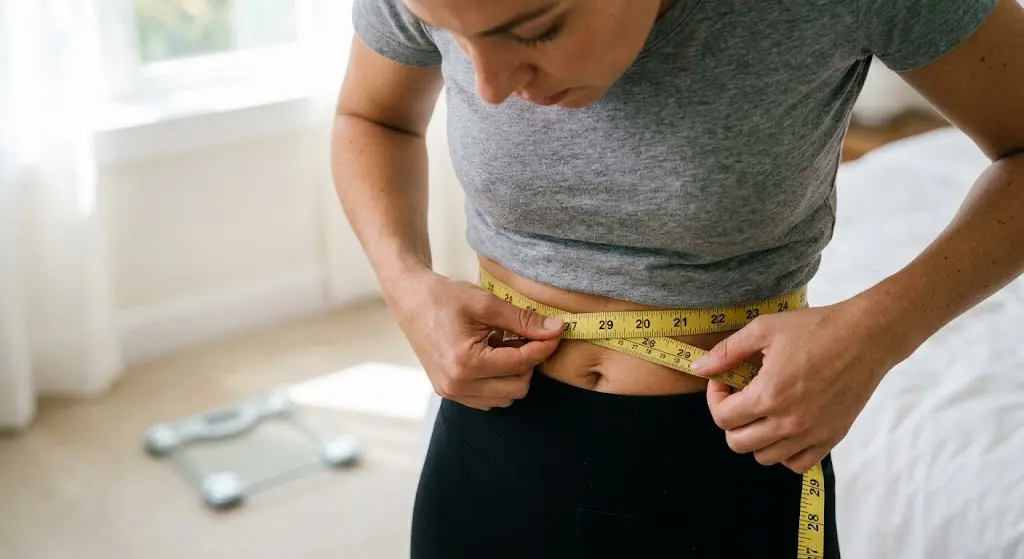
Why does the scale not move even when I am losing fat? Water retention, muscle gain, and normal daily fluctuations all affect the number on the scale. Waist measurements and how your clothes fit are often more accurate signs of fat loss.
Is sweating a sign you are burning fat? No. Sweat is your body cooling itself down. It causes temporary water loss, not fat loss, and that water weight returns once you rehydrate.
Conclusion and Next Steps
When you lose weight where does it go comes down to basic chemistry. Fat breaks apart into carbon dioxide and water, and your lungs handle the bulk of the work by exhaling it out. Nothing mystical happens, and nothing gets flushed out through your digestive system either.
Knowing this will not make the process faster, but it might make it less confusing. Fat loss is slow and mostly invisible while it happens, and that is normal.
If you are working on your own routine, start with our [internal link: beginner weight loss guide] for a step by step plan, or check out [internal link: high protein meal ideas] to protect muscle while you cut calories.
CTA: Ready to build a plan that actually sticks? Visit www.Healthforlifee.com for free meal templates and the exact tracking method used in this article.
Disclaimer: This article is for general educational purposes only and is not a substitute for professional medical advice. Talk to a doctor or registered dietitian before starting any weight loss program, especially if you have an existing health condition.