
Military calisthenics turned my shoulders into something resembling stone before a single barbell ever touched my hands. I was 34, out of shape, and staring down a fitness test I had no business passing. Three months of push-ups, pull-ups, and plank holds later, I passed with points to spare and gained a lot more than a passing score.
No gym membership. No fancy machines. Just my own bodyweight, a pull-up bar bolted to a doorframe, and a stubborn refusal to quit.
That single stretch of training changed how I think about fitness completely, and it is exactly why I built this site.
What Military Calisthenics Actually Means
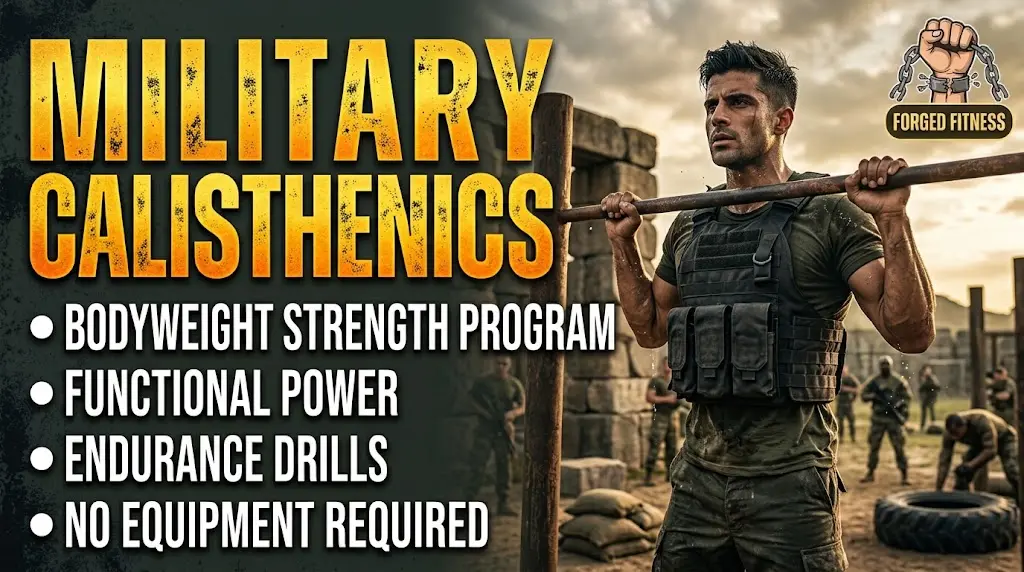
Military calisthenics is a bodyweight training method armed forces use to build strength, muscular endurance, and mental toughness with zero equipment. It centers on push, pull, squat, and core movements like push-ups, pull-ups, and planks, performed in high-rep circuits designed to prepare soldiers for the physical demands of combat.
The training philosophy behind it is simple. Movement quality comes first. Consistency comes second. Progressive overload comes always. You do not need advanced gymnastics skills or years of gym experience to start this kind of training.
You need a doorframe pull-up bar, a patch of open floor, and a plan you will actually follow through on.
Bodyweight training scales to any fitness level because the only equipment you are adjusting is rep count, tempo, and rest time.
This is exactly why the method spread far beyond military barracks. Athletes, first responders, and everyday people now borrow the same push-pull-squat-core structure because it delivers real results without a monthly membership fee.
Why I Started Training This Way
When I began training for my own fitness test, most advice I found online read like it came from someone who had never attempted a single hand-release push-up. That gap in honest, hands-on training content is exactly why I started logging my own workouts on Health for Life (healthforlifee.com). I wanted a place where the routines came from real sweat, not a recycled spreadsheet.
My first week was rough. I could barely manage eight real push-ups with clean form, and my grip gave out after ten seconds on the pull-up bar. By week six, I was stringing together sets of 20 push-ups without breaking form. By week twelve, pull-ups had stopped feeling impossible.
Nothing about that progress involved a secret technique. It was the same push-pull-squat-core rotation, repeated consistently, with slightly harder variations added every couple of weeks.
The Five Movements That Matter Most
Every serious military calisthenics program is built from five core movement patterns. Master these and the rest of your training becomes small variations on a proven theme.
- Push: Standard push-ups, hand-release push-ups, and dips build the chest, shoulders, and triceps you need for any pushing task.
- Pull: Pull-ups, chin-ups, and inverted rows develop the back and grip strength that carries a loaded rucksack for miles.
- Squat: Bodyweight squats, lunges, and step-ups build the leg strength behind every road march and obstacle course.
- Core: Planks, leg raises, and flutter kicks stabilize your spine so your limbs can work under real load.
- Run and carry: Sprints, ruck marches, and farmer carries tie strength and conditioning together into usable, real-world fitness.
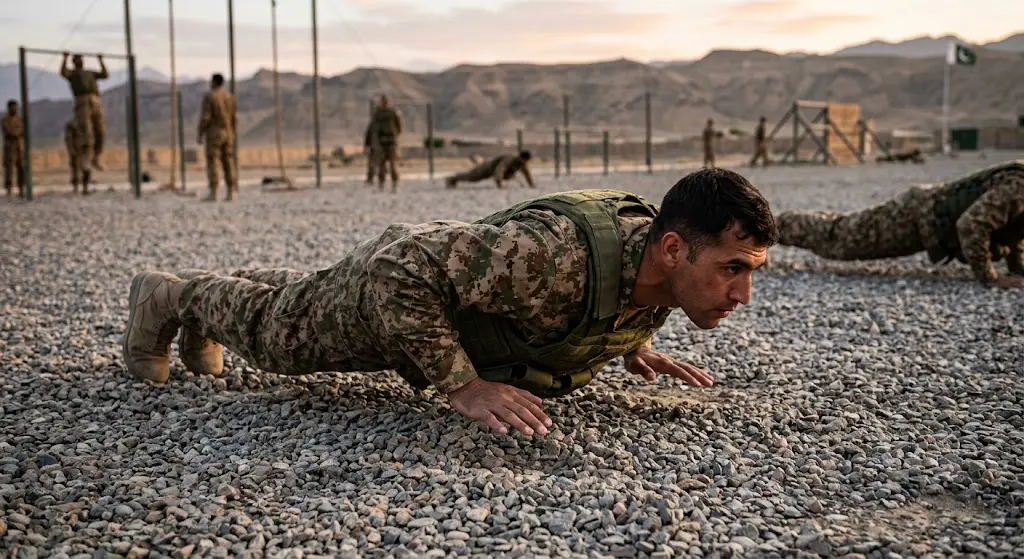
None of these movements require a scanned barcode at a gym counter. That is the entire point of training this way.
A Sample Military Calisthenics Workout
Here is a workout structure I still use today, scaled across three experience levels.
| Level | Push-Ups | Pull-Ups | Squats | Plank | Run |
|---|---|---|---|---|---|
| Beginner | 3 sets x 10 | 3 sets x 3 (assisted) | 3 sets x 15 | 3 x 20 sec | 1 mile, easy pace |
| Intermediate | 4 sets x 20 | 4 sets x 8 | 4 sets x 25 | 4 x 45 sec | 2 miles, moderate pace |
| Advanced | 5 sets x 30 | 5 sets x 12 | 5 sets x 35 | 5 x 60 sec | 2 miles, fast pace |
Rest 60 to 90 seconds between sets at every level. Add one rep per set each week before you move up to a harder variation or a longer distance.
Pick the row that matches where you are right now, not where you want to be in six months. Rushing the progression is the fastest way to end up injured instead of improved.
How This Connects to the Army Fitness Test
The Army retired the old Army Combat Fitness Test on June 1, 2025, and replaced it with the Army Fitness Test, or AFT. Calisthenics movements sit at the center of two of its five graded events.
The Hand-Release Push-Up and the Plank both come directly from bodyweight training, no barbells or machines involved. Soldiers in general roles need a total score of 300 across all five events, while those in combat specialties now train toward a single sex-neutral standard requiring 350 points, with a 60-point minimum on every individual event. Full scoring tables and event standards are published on the Army’s official AFT page.
You cannot deadlift or sprint your way out of a weak push-up score. The calisthenics-based events are graded entirely on their own.
None of this means you need to enlist to benefit from the training. The same event standards simply give civilians a real, measurable benchmark to train against, which beats guessing whether your fitness is actually improving.
Building Your Own 4-Week Progression
Progressive overload is the only training rule that actually matters over the long run. Here is the simple structure I hand to anyone starting from zero.
WEEK 1: Establish your baseline
  - Test max push-ups, max pull-ups (or rows), and plank hold time
  - Train 3 days this week, full-body circuit each session

WEEK 2: Add volume
  - Add one set to every movement from Week 1
  - Train 4 days, alternating upper-body and lower-body emphasis

WEEK 3: Add difficulty
  - Swap standard push-ups for hand-release push-ups
  - Add a light backpack to squats and lunges if available

WEEK 4: Test and reset
  - Retest max reps and plank hold time
  - Compare the results against your Week 1 baseline
  - Build Weeks 5 through 8 around your new numbers
Track every session, even the bad ones. A simple notebook works just fine for this. The number that matters most is the trend line over weeks, not the result of any single workout.
Mistakes That Slow Down Your Progress
I made every single one of these mistakes myself before figuring out what actually works.
- Skipping the warm-up: Cold shoulders and cold hips lead to strains, not strength gains.
- Chasing reps over form: A half push-up does not count for anything except your ego.
- Ignoring rest days: Muscle and connective tissue rebuild during recovery, not during the workout itself.
- Training randomly: Bouncing between routines with no clear structure stalls real progress fast.
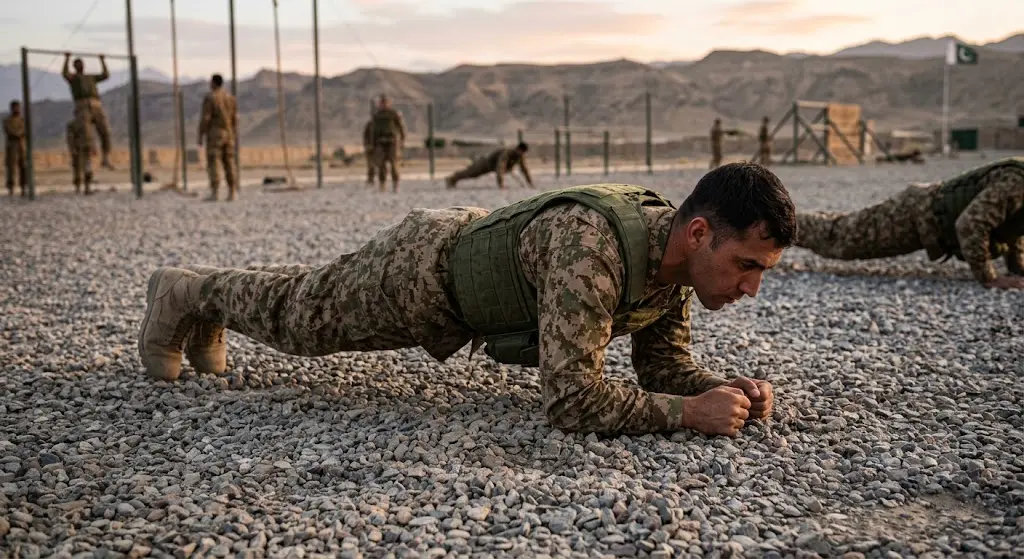
The CDC recommends at least two days a week of muscle-strengthening activity for general adult health, and a structured calisthenics routine like this one clears that bar without much extra effort.
FAQs
What is military calisthenics? Military calisthenics is a bodyweight training method that uses push-ups, pull-ups, squats, and core work to build the strength and endurance needed for military-style physical fitness tests.
Do you need equipment for military calisthenics? No. The core movements need only bodyweight and open floor space. A pull-up bar helps but doorframe versions work fine for beginners.
How many days a week should I train? Most people make solid progress training three to five days a week, with at least one full rest day built in.
Can calisthenics alone prepare you for the Army Fitness Test? Calisthenics covers the Hand-Release Push-Up and Plank events directly. The Deadlift and Sprint-Drag-Carry events benefit from added strength and sprint work alongside your bodyweight training.
Is military calisthenics good for beginners? Yes. Every movement scales down through assisted variations, reduced reps, or shorter hold times, which makes it one of the most beginner-friendly training styles available.
Disclaimer: This article is for general informational purposes only and does not constitute medical or fitness advice. Consult a physician before starting any new exercise program, particularly if you have an existing health condition or are training toward official military fitness standards.