
Why Dumbbell Back Exercises Work
Dumbbell back exercises saved my training the year my gym closed for renovations and I was stuck with nothing but a pair of adjustable dumbbells in a garage. I figured my back day was done for. It wasn’t.
A pair of dumbbells and a hinge pattern can train nearly every muscle a lat pulldown machine hits, just with your core doing extra work to stay stable.
I started logging every session on healthforlifee.com, mostly to keep myself honest about whether the weight was actually going up. Six weeks in, my rows felt heavier and my shirts fit differently across the shoulders.
Dumbbell back exercises give you unilateral loading, a longer range of motion than most machines, and zero waiting for equipment. Each side of your body works independently, so a strong side can’t quietly cover for a weak one.
The Muscles These Exercises Train
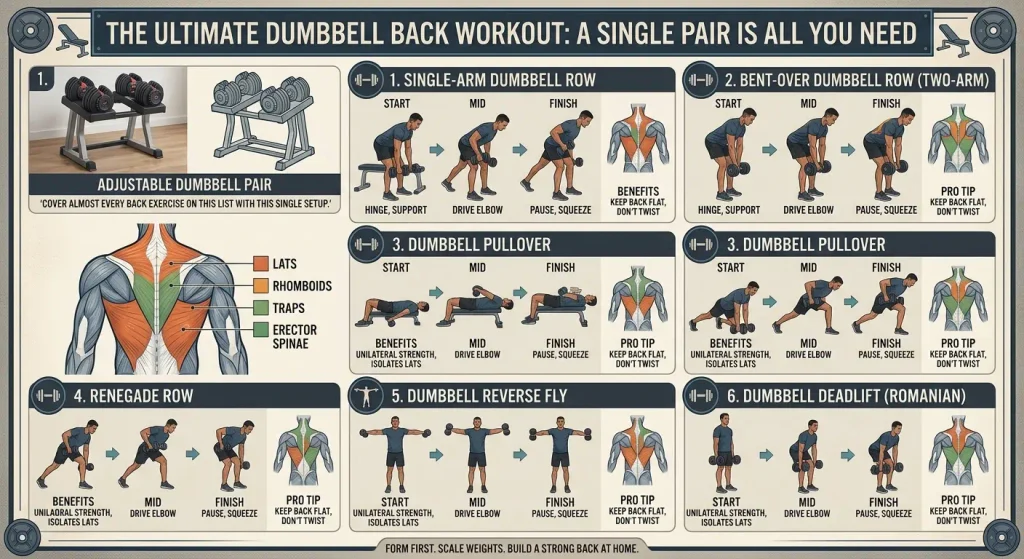
Your back isn’t one muscle. It’s five major groups working together, and a good routine hits all of them.
- Latissimus dorsi (lats): the wide muscles behind your armpits, responsible for that V-taper look
- Rhomboids and mid traps: squeeze your shoulder blades together on every row
- Erector spinae: the muscles running along your spine, trained by hinges and deadlifts
- Rear deltoids: technically shoulder muscles, but trained hard by reverse flys
- Lower traps: stabilize your shoulder blades during pulling movements
Skip any one of these and your back develops unevenly, which shows up as rounded shoulders or lower back fatigue during other lifts.
The Best Dumbbell Back Exercises, With and Without a Bench
The best dumbbell back exercises without a bench are the standing bent-over row, the suitcase deadlift, the dumbbell pullover done on the floor, and the renegade row. None require support equipment, and all of them load the lats, traps, and erectors through a full range of motion.
With a Bench
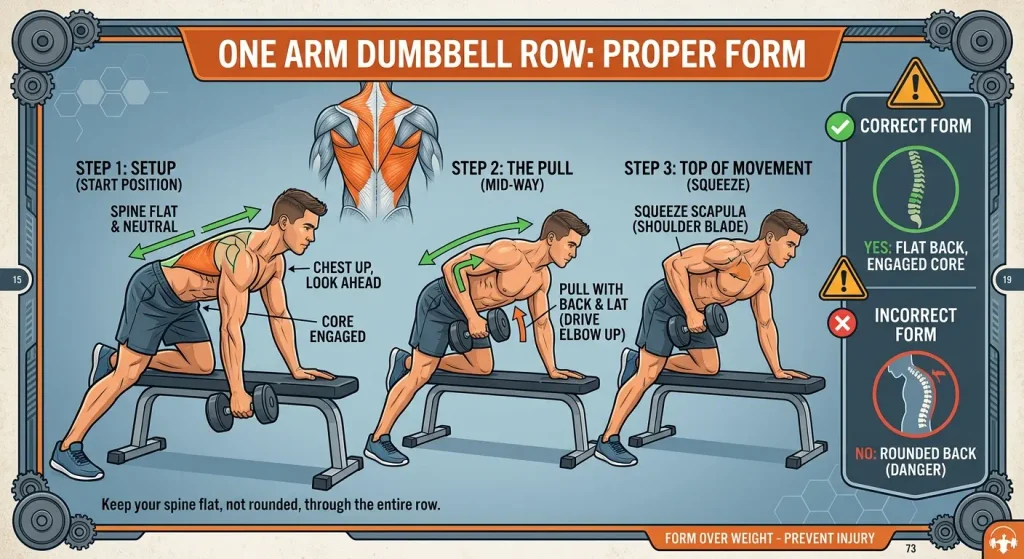
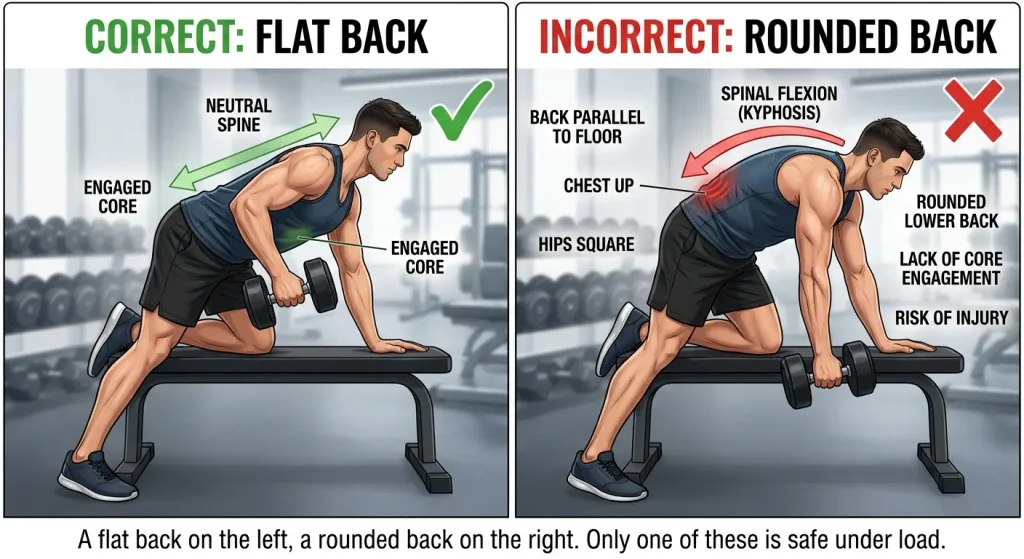
- One-arm dumbbell row. Knee and hand on the bench, opposite leg planted, row the dumbbell to your hip. This is the single best move for lat thickness because you can load each side heavy without your lower back compensating.
- Chest-supported row. Lie face down on an incline bench and row both dumbbells up. Removes momentum entirely, which makes it the safest option if your lower back is cranky.
- Incline dumbbell pullover. Stretches the lats through a long range and doubles as light chest and serratus work.
Without a Bench
- Standing bent-over row. Hinge at the hips to roughly 45 to 60 degrees, flat back, row both dumbbells to your hip bones.
- Single-arm suitcase deadlift. Trains the erectors and obliques while teaching your core to resist side bending.
- Floor dumbbell pullover. Same stretch as the bench version, just performed lying on the floor with knees bent.
- Renegade row. From a plank, row one dumbbell at a time. Brutal for core stability alongside the back.
- Dumbbell high pull. A hip-hinge into an explosive pull, good for rear delts and upper traps.
- Reverse fly. Bent slightly at the hips, raise both dumbbells out to the sides to isolate the rear delts and rhomboids.
How to Build a Wider Back With Dumbbells
Width comes almost entirely from the lats, so building a wider back with dumbbells means prioritizing pullovers, wide-grip rows, and any row variation that lets your arm travel past your torso. Rows pulled to the hip, not the chest, keep tension on the lats instead of shifting it to the upper traps.
Two habits make the biggest difference here. First, let your shoulder blade protract fully at the bottom of every rep instead of stopping short. Second, pause for a half second at the top of the pull to actually feel the lat contract instead of just moving weight from A to B.
Dumbbell Rows vs Bent-Over Barbell Rows
Both build a strong back. The right one depends on your goals and your lower back’s tolerance for load.
| Factor | Dumbbell Row | Barbell Bent-Over Row |
|---|---|---|
| Range of motion | Longer, unrestricted by a bar | Shorter, bar stops at torso |
| Muscle balance | Trains each side independently | Stronger side can compensate |
| Lower back demand | Lower, especially chest-supported | Higher, constant static hold |
| Load capacity | Limited by grip and dumbbell size | Higher total load possible |
| Best for | Beginners, home training, injury prevention | Advanced lifters chasing max strength |
If your lower back tends to round under load, Healthline’s breakdown of the bent-over row is worth reading before you add weight.
A Home Dumbbell Back Workout for Hypertrophy
A home dumbbell back workout for hypertrophy needs roughly 10 to 20 hard sets per week, split across two or three sessions, in the 6 to 15 rep range taken close to failure. That volume range is what a systematic review published through PubMed found most consistently drives muscle growth once training experience passes the beginner stage.
Here’s the exact split I run at home, laid out like a program card so you can copy it straight into a notes app.
DUMBBELL BACK DAY, TWICE A WEEK

Day A (bench available)
1. One-arm dumbbell row       4 sets x 8-10 reps
2. Chest-supported row        3 sets x 10-12 reps
3. Incline dumbbell pullover  3 sets x 12-15 reps
4. Reverse fly                3 sets x 12-15 reps

Day B (no bench needed)
1. Standing bent-over row     4 sets x 8-10 reps
2. Renegade row                3 sets x 8 reps per side
3. Single-arm suitcase deadlift 3 sets x 10 reps per side
4. Dumbbell high pull          3 sets x 12 reps

Rest 60-90 seconds between sets. Add weight once every set
hits the top of its rep range with solid form.
[INTERNAL LINK PLACEHOLDER: Full Body Dumbbell Workout Plan -> /full-body-dumbbell-workout]
The NASM guide to hypertrophy programming backs up starting new lifters at the lower end of that set range and building up over several weeks rather than jumping straight to 20 sets.
Lower Back Dumbbell Exercises for Size and Strength
Lower back dumbbell exercises for size and strength center on hip-hinge patterns, mainly the Romanian deadlift and the good morning, both of which train the erector spinae isometrically as it resists rounding under load.
- Dumbbell Romanian deadlift: soft knees, hinge the hips back, dumbbells stay close to the shins
- Dumbbell good morning: dumbbells held at the shoulders, same hip hinge, shorter range of motion
- Superman hold: bodyweight only, but a smart finisher to build endurance in the erectors
Go lighter than you think you need on all three. The lower back responds to control, not load.
Mistakes That Wreck Your Form
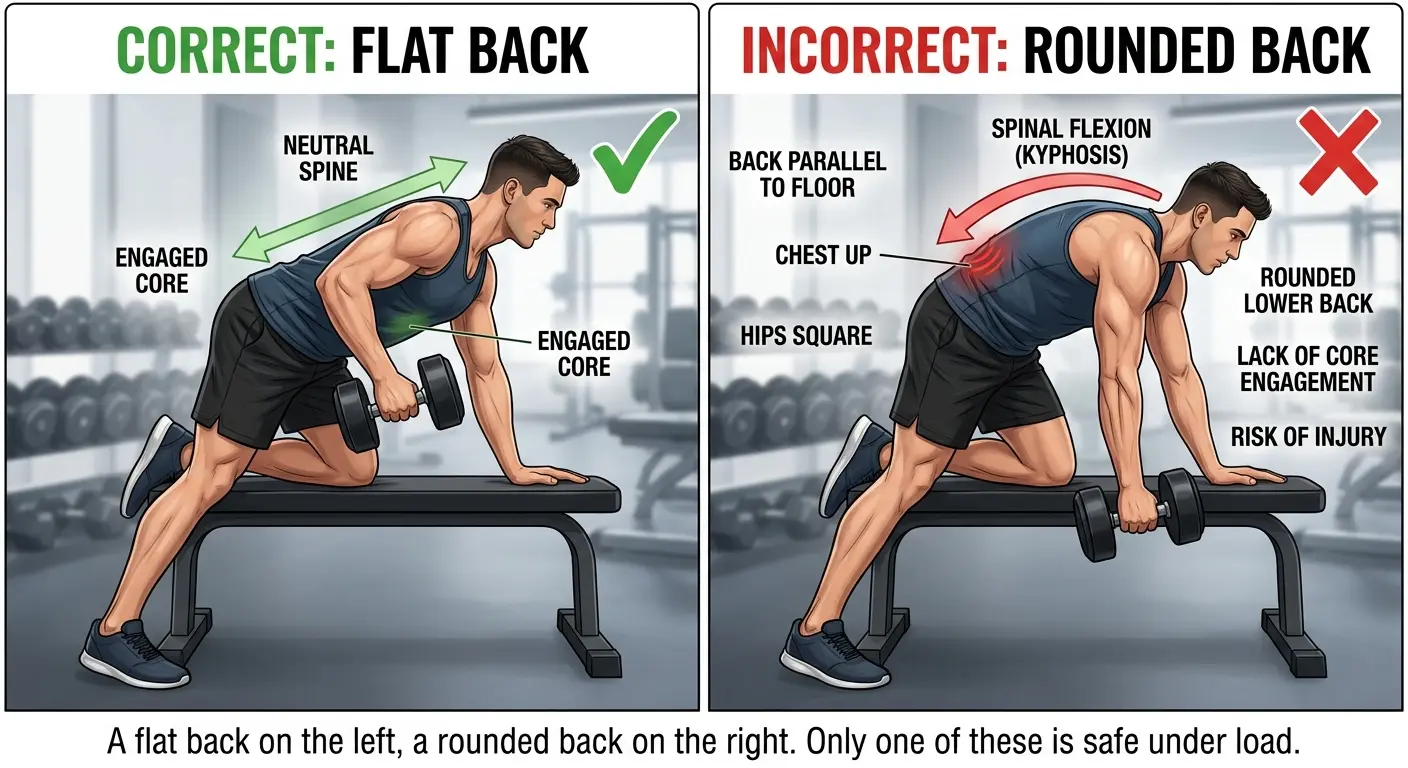
Rounding the lower back is the single most common and most dangerous mistake across every dumbbell back exercise on this list. A rounded spine under load shifts stress off your back muscles and onto your discs.
Other habits worth fixing:
- Pulling to the chest instead of the hip, which turns a row into a shrug variation
- Letting the dumbbell tilt forward in your grip, which hands the work over to your biceps
- Using momentum to heave the weight up instead of controlling both the lift and the lower
FAQs
What is the best dumbbell exercise for a thicker back? The one-arm dumbbell row tops most lists because it lets you load each lat heavily while the bench supports your torso, keeping your lower back out of the equation entirely.
Can you build a full back with just dumbbells? Yes. Combining heavy rows, a hip-hinge movement, and rear delt work covers all five major back muscles without needing a cable machine or barbell.
How many days a week should I train back with dumbbells? Two sessions a week hits the 10 to 20 weekly set range most research links to muscle growth, while still leaving enough recovery time between sessions.
What’s the best dumbbell back exercise without a bench? The standing bent-over row, since it trains the same muscles as the supported version and only requires enough space to hinge forward safely.
Are dumbbell rows safer than barbell rows for beginners? Generally yes. The shorter learning curve and lower static load on the lower back make dumbbell rows a more forgiving starting point.
Final Word
Nine months after my gym reopened, I kept the dumbbell rows in my program anyway. They built a back that machines never quite reached the same way.
Track your own numbers somewhere, even if it’s just a notes app. The habit matters more than the tool.
Ready to build your own routine? Start with Day A above this week and see how your back feels by Friday.
Disclaimer: This article is for general educational and informational purposes only and does not constitute medical or professional fitness advice. Consult a physician or certified trainer before beginning any new exercise program, especially if you have an existing back injury or medical condition.