
Author Note: Reviewed by the Health for Life editorial team, home cooks who test every recipe with an instant-read thermometer before it goes live on the site.
Steak temps decide everything about how your dinner turns out, and most of the ruined steaks I’ve eaten at other people’s houses came down to one thing: nobody checked the number. A steak that looks done on the outside can still be raw in the middle, and a steak that looks underdone might already be past medium. Your eyes lie. A thermometer doesn’t.
Table of Contents
- The Steak Temperature Chart
- What Each Doneness Level Actually Looks Like
- Why Resting Changes the Number
- How I Learned to Stop Guessing
- The Right Way to Check Steak Temp
- Common Mistakes That Wreck a Good Cut
- Steak Temps by Cooking Method
- FAQs
- Conclusion
The Steak Temperature Chart
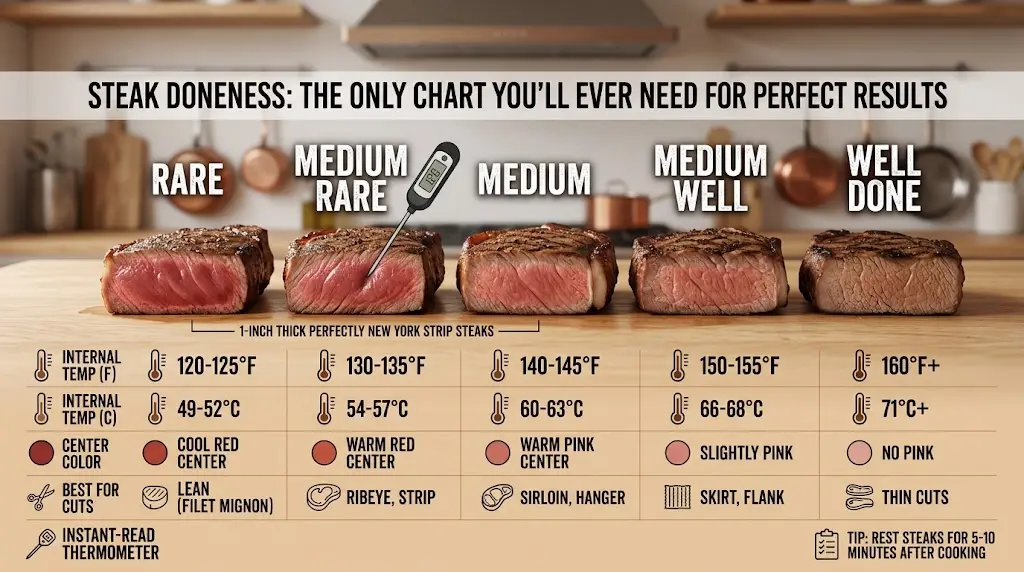
Here’s the number you actually came for. Pull your steak at these internal temperatures for the doneness you want:
- Rare: 120–125°F
- Medium Rare: 130–135°F
- Medium: 140–145°F
- Medium Well: 150–155°F
- Well Done: 160°F and up
Key takeaway: The USDA’s official safe minimum for whole-muscle beef steaks is 145°F, followed by a 3-minute rest. That lands right around medium, so if food safety is your main concern, medium is the floor, not rare or medium rare.
Ground beef is a different animal entirely. Because grinding mixes surface bacteria all through the meat, burgers need to hit 160°F no matter what doneness you’d normally prefer in a whole steak.
What Each Doneness Level Actually Looks Like
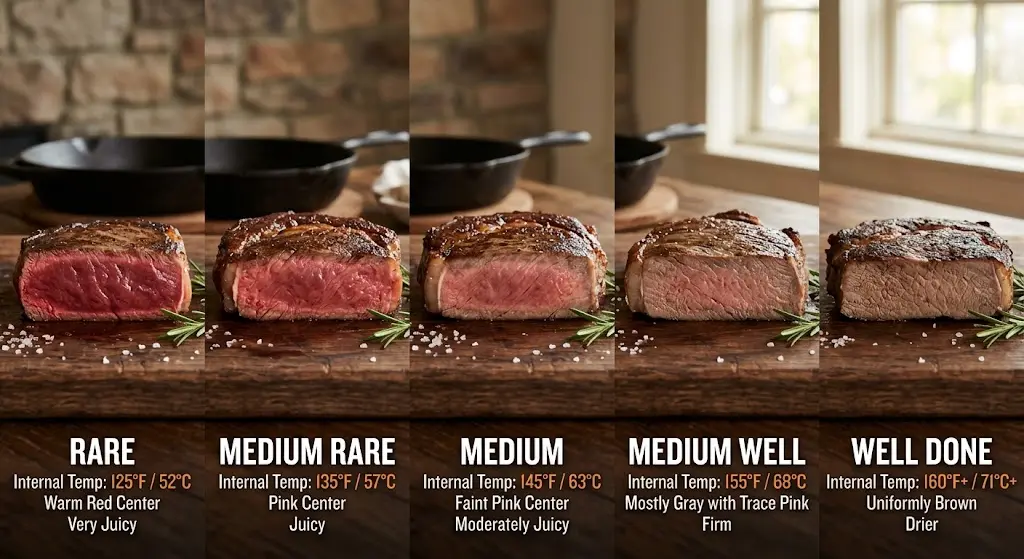
Rare steak has a cool, deep red center and feels soft when you press it, almost like the pad of your thumb when your hand is relaxed. Medium rare firms up slightly and turns a warm red with a little pink at the edges. This is the one most steakhouses default to unless you say otherwise.
Medium gives you a pink center with noticeably more give lost, and the flavor gets a bit more pronounced as the fat renders further. Medium well leaves just a thin blush of pink in the middle. Well done is gray-brown edge to edge, and honestly, it’s the hardest one to keep juicy since there’s so little moisture left to work with.
Why Resting Changes the Number
This part trips up a lot of home cooks. A steak’s internal temperature keeps climbing for a few minutes after you take it off the heat, usually by 5 to 10 degrees depending on thickness and how hot your pan or grill was. That’s called carryover cooking.
So if you want a final serving temperature of 135°F, you pull the steak at closer to 125-130°F and let it rest on a cutting board, tented loosely with foil, for 5 minutes. Skip that step and you’ll consistently overshoot your target by the time you cut into it.
How I Learned to Stop Guessing
I used to cook steak the way my dad did: press it with a finger, compare it to the feel of your palm, call it done. It worked maybe half the time. The other half, I served my in-laws a ribeye that was still cold in the center, and nobody said anything, but I saw the look.
That was the night I bought a $12 instant-read thermometer, and it’s genuinely one of the cheapest upgrades I’ve made to how our family eats. Over on Health for Life (www.healthforlifee.com), we talk a lot about the small, low-cost changes that make home cooking both safer and better, and a meat thermometer is at the top of that list. It’s not just about hitting the right doneness. It’s about knowing for certain that the beef you’re feeding your kids has cleared a safe internal temperature, instead of hoping the color looks right under kitchen lighting.
The Right Way to Check Steak Temp
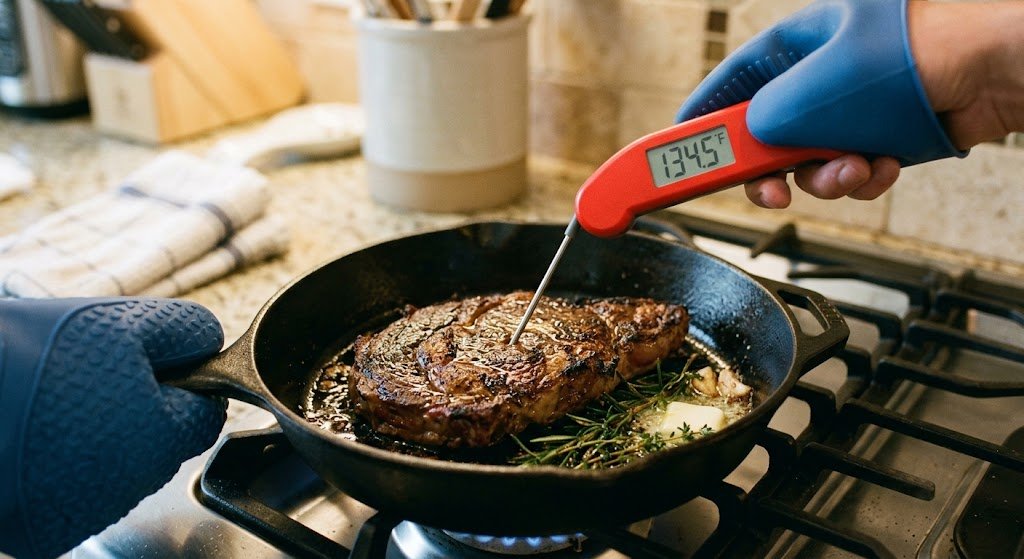
Push the thermometer probe into the thickest part of the steak, in from the side rather than straight down through the top, so the tip sits in the center of the meat rather than near the edge or bone. Avoid touching bone or the pan itself, since both throw the reading way off.
Check it in the last minute or two of cooking rather than constantly poking the steak, since every poke lets juice escape through that hole. One accurate check near the end beats five anxious ones throughout.
Common Mistakes That Wreck a Good Cut
Cooking straight from the fridge. A cold steak cooks unevenly, with a gray overcooked band around a cool center. Let it sit out for 20-30 minutes first.
Cutting immediately after cooking. This is the fastest way to lose all your juices onto the cutting board instead of into the meat. Rest it.
Relying on cook time instead of temperature. Thickness, starting temperature, and your stove’s actual heat output all vary too much for a fixed number of minutes to be reliable.
Using a dial thermometer for a thin cut. Dial thermometers need to be inserted a couple of inches deep to read accurately, which doesn’t work on a 3/4-inch strip steak. An instant-read digital probe is worth the small cost for anyone who cooks steak more than a few times a year.
Steak Temps by Cooking Method
Grilling, pan-searing, and reverse-searing all get you to the same final internal temperature, but the path there differs enough to matter.
- Grilling: High, direct heat browns the surface fast, so pull the steak 5°F early since carryover runs hotter on a grill.
- Pan-searing: A cast-iron pan holds heat well and gives you the most control, especially when you finish with butter and herbs at the end.
- Reverse searing: Cooking low and slow in the oven first, then finishing with a hard sear, gives the most even edge-to-edge color for thick cuts over 1.5 inches.
Whatever method you use, for method-specific timing, and check the USDA food safety guidelines for beef for the official minimums.
FAQs
What temperature is medium rare steak? Medium rare steak is 130-135°F internally, with a warm red center and a slightly firm texture. Pull it around 125-130°F and let carryover cooking finish the job during the rest.
Is it safe to eat steak at 125°F? A whole-muscle steak at 125°F sits below the USDA’s 145°F recommendation, so there’s a food safety trade-off. Many people eat rare and medium rare steak safely, but the extra risk comes from the outer surface, which is why searing the outside fully still matters even at lower target temps.
How long should steak rest after cooking? Rest steak for 5 minutes for a standard 1-inch cut, or up to 10 minutes for anything over 1.5 inches thick. This lets carryover cooking finish and keeps the juices inside when you cut into it.
Why does my steak temp keep rising after I take it off heat? Heat continues moving from the hot exterior into the cooler center for several minutes after cooking stops, raising the internal temperature by 5-10°F. This is why you always pull steak a few degrees before your actual target.
Conclusion
Steak temps aren’t complicated once you stop trusting your eyes and start trusting a thermometer. Pull rare at 120-125°F, medium rare at 130-135°F, medium at 140-145°F, and remember that the number keeps climbing for a few minutes after the pan or grill. Get that part right and the rest of steak night takes care of itself.
CTA: Grab an instant-read thermometer before your next steak night, and check out more practical, low-cost kitchen upgrades over on Health for Life.